Honor Guard Awards · buyer guide
How to measure memorabilia for a service display
For worldwide Honor Guard Awards orders, inventory and measure the actual memorabilia before choosing the service display. Record width, height, depth, orientation and ownership separately from the frame or purchased components. A front photograph can explain the arrangement, but the proposed construction needs dimensions and any preservation review appropriate to the supplied objects.
Reviewed 2026-09-05 · AI-assisted editorial review. General buying guidance; illustrative scenarios are not customer case studies. Images are AI-generated concepts.
List every item the owner wants considered: coins, patches, photographs, ribbons or other keepsakes. Assign a neutral identifier and record who owns each object. Distinguish items definitely intended for display from optional references so a concept does not imply everything must be included. Ask the owner which item should be visually central and which can be omitted if space becomes limited. A frame selected before this inventory may force an awkward arrangement or unnecessary handling of valuable pieces. Use photographs for the first discussion where possible, with written dimensions supplied separately. The display proposal should respond to the actual collection and the owner’s priorities rather than an assumed standard set of memorabilia.
How do you measure width, height and depth separately?
For each object, record its widest horizontal extent, tallest vertical extent and deepest projection in the intended display orientation. A flat photograph and a coin in a protective holder create different depth requirements even when their face dimensions are similar.
Note whether the measurement includes an existing sleeve, backing or case that the owner wants retained. Keep units consistent and label estimated values clearly. Do not compress a three-dimensional object into one diameter field merely because it appears round from the front. Ask the proposed display specialist which additional measurements are needed for the actual construction. The buyer’s worksheet should make the object understandable without prescribing a universal clearance or mounting method.
MilitaryPlaques.com requests coin diameter and depth for its coin-holder plaque.

Sources: MilitaryPlaques.com: Presentation Plaque with Coin Holder
How do you show the preferred orientation and visible face?
Photograph the front, back and side of any item whose orientation or attachment is not obvious. Mark which face should be visible and whether the owner wants both sides accessible. A two-sided coin may carry important information on its reverse, while a patch may have an existing backing the owner does not want altered.
Record these preferences before a layout makes one view appear final. If the object can be rotated or removed, ask the specialist to describe the proposed arrangement and its limitations. Do not infer that a rendered front view establishes how the item will be supported. The visible composition and the physical interface need to be reviewed together.
How do you keep preservation questions with the right specialist?
An irreplaceable photograph, textile or personal object may raise handling and display questions beyond a decorative plaque order. Ask the owner whether originals must remain unaltered and whether a reproduction could serve the intended visual purpose. Refer conservation or specialized mounting questions to an appropriate professional for the actual materials involved.
This guide does not recommend adhesives, environmental limits or a preservation treatment. Its practical recommendation is to document the object’s condition, value to the owner and any restrictions before a physical transfer. If a nonvaluable sample or measured reproduction can resolve a layout question, discuss that option first. A visually appealing proposal should not hide an irreversible change to a keepsake that the family intended to preserve intact.
How do you test the whole arrangement at proposed size?
Create a paper or digital layout using the measured footprints of the supplied items and the proposed inscription area. Label it as a layout study rather than a construction approval. Check whether the focal item, name and supporting pieces have the intended hierarchy.
Include the longest approved text and any existing holders so the composition is not based on artificially reduced objects. Ask the specialist to return the proposed internal and overall dimensions, not just an attractive front rendering. If one item makes the arrangement disproportionately large, discuss a separate companion display rather than assuming every object must fit inside one frame. The owner should approve that editorial choice before detailed production work proceeds.
How do you document any physical transfer?
If original items must be sent for review or incorporation, agree on the recipient, item list, condition record and return arrangement before shipment. The owner should know which objects leave their care and why. Keep delivery details and declared contents accurate for the actual transfer, and obtain current provider guidance where needed.
Do not include an original merely because the concept image shows it; confirm that the production team expects and can handle that item under the agreed proposal. Record what happens if the project changes or an item is unsuitable for the proposed construction. This creates a clear handoff for personal property without promising a particular preservation or shipping outcome.
Use the article’s example files
Sample rows are illustrative and are not production instructions. Replace their assumptions, keep private records separately and complete the approval fields before using the sheet for a real order.
How do you receive the display against the supplied-item list?
When the completed display returns, compare the visible objects and any separately returned items with the original inventory. Check the approved orientation, inscription and component scope. If the owner chose reproductions, confirm that the original objects remain accounted for outside the display.
Retain the measured schedule and final proposal for future additions, but do not assume a new item can be fitted without another review. A later coin or photograph may change depth, arrangement or handling needs. Keep a record of what the completed display actually contains so a family member does not have to dismantle or guess at the construction to explain it years later. The finished object and the custody record should tell the same story.
How does this illustrative planning example work?
For a fictional association display project, twelve small supplied-item panels are planned, with two separate title pieces and one explicitly approved spare blank component. The quantity tool counts fifteen purchased components; it does not count coins or establish frame dimensions.
The measurement worksheet separately records each memorabilia item’s width, height, depth and intended orientation. If the component plan changes after the measured layout review, the organizer updates the calculator inputs instead of treating the first total as fixed. Enter twelve measured memorabilia panels at one panel per display, two separate title pieces and one explicitly approved spare blank component. The purchased-component total is twelve plus two plus one, or fifteen. Supplied photographs, patches and coins are recorded separately and are not additional purchased panels. A panel’s depth is also separate from its count: twelve confirmed panels still require twelve compatible measured layouts. If the owner adds another supplied coin, review that display’s dimensions before assuming the purchase quantity or construction remains unchanged.
Optional calculation: Count display components alongside supplied memorabilia
Display original memorabilia or Use approved reproductions: which fits the intended recognition?
Original memorabilia places the owner’s actual objects inside the display and needs a clear custody and preservation plan. Approved reproductions can express the chosen story while the originals remain elsewhere. Compare what each object contributes, what the owner authorizes and which measurements the actual display proposal requires before choosing a frame.
| Option | Display original memorabilia | Use approved reproductions |
|---|---|---|
| Best reason to choose it | Choose this when the owner wants the actual objects incorporated and the appropriate handling proposal is accepted. | Choose this when the visual story can be told while originals remain separately in the owner’s care. |
| Main review question | What restrictions apply to each original, and who approves its support and any physical transfer? | Which reproductions are authorized, and will their scale and appearance be clear in the final proof? |
| What to specify | Supply an item-level inventory with dimensions, orientation, condition references and ownership responsibilities. | Specify the reproduced items, approved source files, intended sizes and where the originals remain. |
| Later change | Any later rearrangement of originals should revisit the owner’s custody and relevant preservation decisions. | A reproduction change needs a new reference and dimension review even when the overall frame stays the same. |
What should the organizer confirm before ordering?
Provide an item inventory with the dimensions and orientation needed for the proposed display. Original memorabilia and approved reproductions can involve different custody and preservation choices. Confirm which pieces are purchased, which are supplied by the owner and which questions require specialist review before a frame proposal becomes a complete order.
What should a measured service-display quote cover?
Ask Honor Guard Awards to separate the purchased display components, personalization and shipping from owner-supplied memorabilia and any specialist work. Provide dimensions and the proposed arrangement before requesting the applicable range or minimum. A frame quoted from a front photograph may not yet address object depth, support, transfer responsibility or the complete intended display scope.
Why is depth needed as well as width and height?
Depth helps describe how the actual object relates to the proposed enclosure or support. Two items with similar front outlines can have different thicknesses or projecting details. Record the requested dimensions in one consistent unit and keep estimates marked as such until the supplier or appropriate specialist has reviewed the actual interface.
Can a reproduction stand in for an original item?
Use a reproduction only when the owner approves it for the story and any reproduction authority is resolved. Identify it honestly in the working record. The display can preserve the intended visual reference without requiring an irreplaceable original to be transferred, but the substitute still needs its own dimensions and layout review.
Who should decide how valuable memorabilia is attached?
Refer preservation-sensitive questions to the appropriate specialist and the object’s owner. The ordering guide does not establish a universal adhesive, fastening method or conservation treatment. Provide the item’s condition and intended arrangement, then keep any unresolved support or handling decision visible instead of treating the decorative frame choice as approval.
Does the fifteen-component sample count the supplied coins?
No. Its fictional purchase contains twelve display panels, two title pieces and one approved spare blank component. Coins and other owner-supplied memorabilia belong on the separate inventory with dimensions and custody details. Changing the measured arrangement can change the purchased component schedule, so the calculator total should follow that reviewed plan.
Sources and scope
The sources below support the cited technical details. The ordering workflows are editorial recommendations. Your project specification, price and schedule are established in the written quote and approved proof.
- MilitaryPlaques.com: Presentation Plaque with Coin Holder · checked 2026-09-05
Which buying guide should you read next?
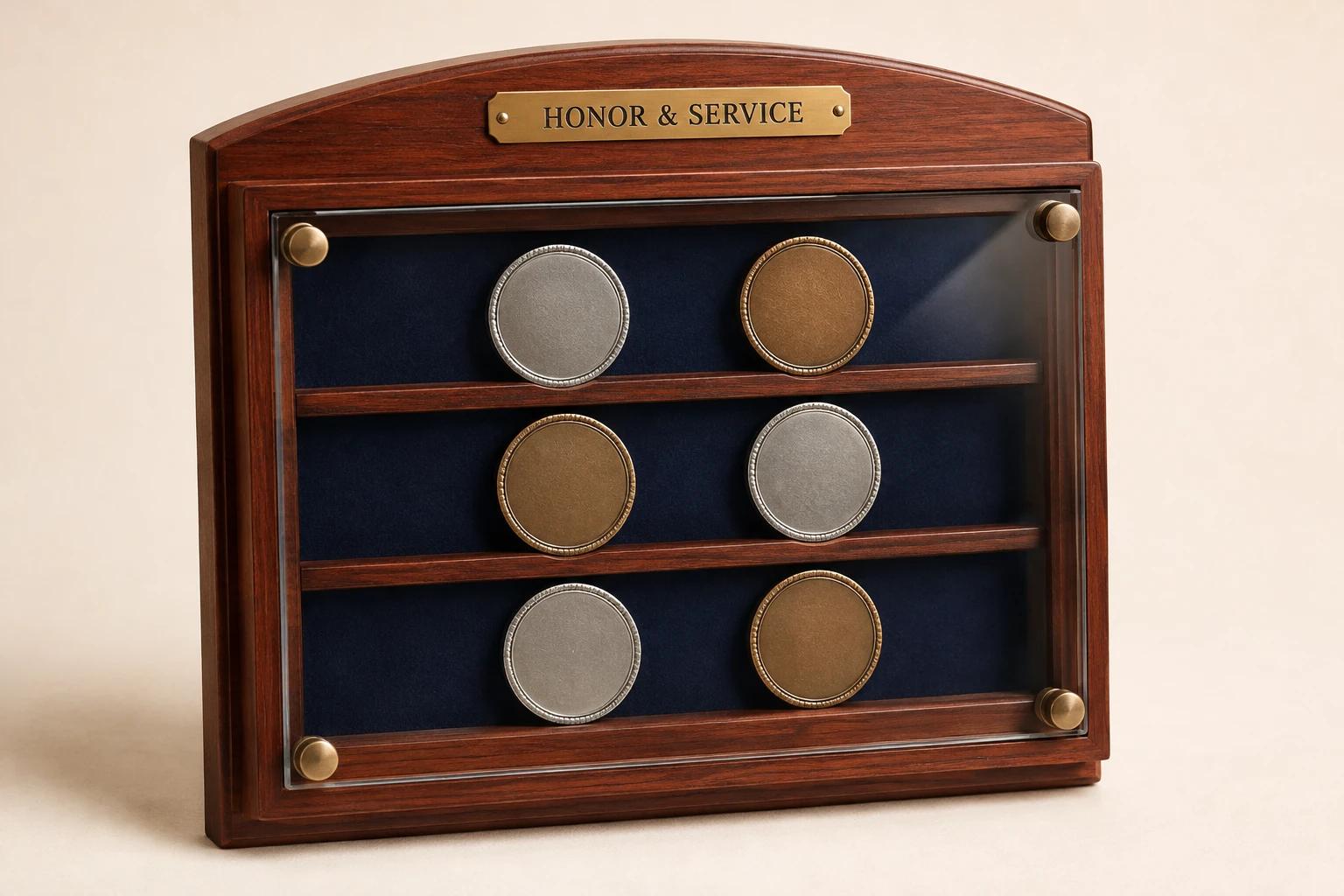
All buying guidesFor worldwide Honor Guard Awards orders, list the coin display, its title components and the owner-supplied coins as separate items. A display position is capacity, not an included coin or spare part. Confirm actual coin dimensions and viewing preferences before deciding whether the quote covers a complete assembly or individually supplied components.
For worldwide Honor Guard Awards orders, write a retirement plaque around an approved career transition and a memorial tribute around the family’s chosen remembrance. Confirm the occasion before selecting dates or borrowing an earlier inscription. Service dates, life dates and the presenters’ personal message should retain their distinct meanings in the proof.