Honor Guard Awards · buyer guide
Coin display components and supplied-item lists
For worldwide Honor Guard Awards orders, list the coin display, its title components and the owner-supplied coins as separate items. A display position is capacity, not an included coin or spare part. Confirm actual coin dimensions and viewing preferences before deciding whether the quote covers a complete assembly or individually supplied components.
Reviewed 2026-09-05 · AI-assisted editorial review. General buying guidance; illustrative scenarios are not customer case studies. Images are AI-generated concepts.
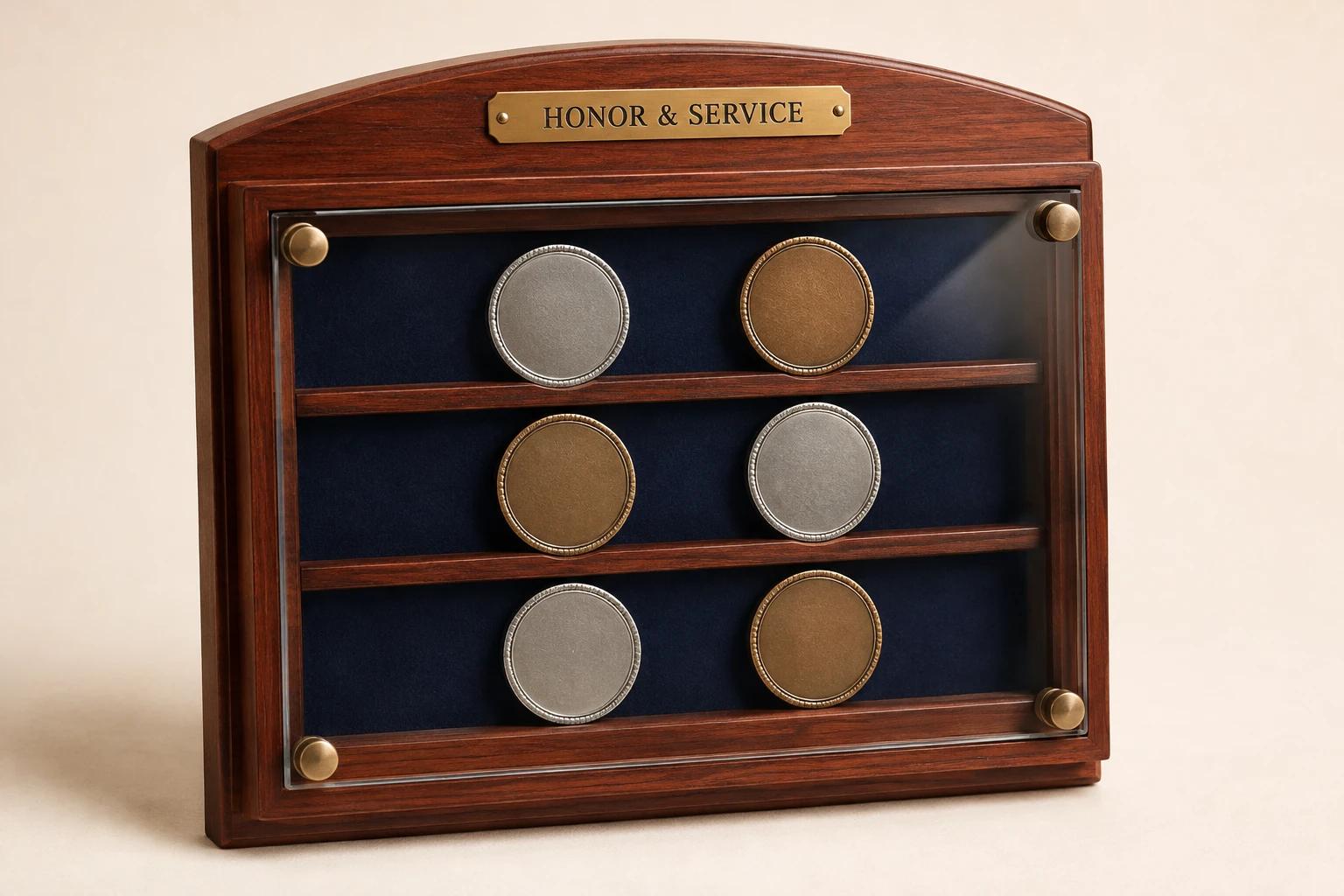
A coin-display image may show a base, supports, an engraved title and several coins. Ask which of those are being purchased and which are supplied by the owner or shown only to illustrate the concept. A display for twelve coins is not necessarily an order for twelve coins, and twelve coin positions do not necessarily mean twelve separate display assemblies. Write a component list before requesting a final quote. Give each supplied coin an identifier and keep its ownership record separate from the purchased components. This distinction prevents a compelling rendering from creating an accidental expectation that personal memorabilia or additional accessories are included in the price of the display.
How do you record each coin’s actual dimensions?
Coins can differ in diameter, outline, thickness and any protective holder. Measure the actual objects in their intended display condition rather than assuming all challenge coins share one standard size. If the owner wants coins left in capsules, include the capsule dimensions and state that preference.
Note unusual shapes or projections that may affect the proposed support. Ask the display specialist to confirm the measurements needed for the actual construction. A list containing only the number of coins cannot establish whether the arrangement will work. Keep the units consistent and distinguish measured values from estimates so any unresolved fit question is visible before the component design is approved.
MilitaryPlaques.com requests coin diameter and depth for its coin-holder plaque.

Sources: MilitaryPlaques.com: Presentation Plaque with Coin Holder
How do you decide whether the reverse should remain visible?
A coin’s front and reverse may tell different parts of the story. Ask the owner whether a single visible face is sufficient or whether the display should allow another view under the proposed construction. Record the selected orientation for each item.
Do not assume that a coin can be removed, rotated or reversed merely because it sits in a rendered slot. Those functions require confirmation for the actual display. If several coins share one narrative, consider arranging them by assignment, occasion or another owner-approved sequence. The physical order should reflect a deliberate story rather than the order in which the coins happened to be photographed or listed in a spreadsheet.
How do you distinguish empty positions from spare components?
An unfilled position in a coin display is capacity, not necessarily a loose spare part. Ask whether the owner wants space for future additions and how those additions would be accommodated. Keep future coin positions separate from purchased spare supports or blank title plates.
If a later coin could differ materially in size, do not promise that the reserved position will accept it without review. A concept can show future capacity with a clearly labeled placeholder, while the order lists only the approved physical assembly and components. This helps the owner understand what is delivered now and what would require another design or purchase decision later.
How do you approve the title plate independently from the collection?
The engraved title can identify a person, an occasion or the collection’s theme, but it should not claim an unverified entitlement for every coin shown. Ask the owner to approve the exact wording and any dates for this particular display.
If the collection includes gifts or commemorative pieces from different sources, a general personal dedication may be more accurate than a heading implying they are all official awards. Keep the title proof linked to the display drawing so its size and placement are reviewed in context. A later title replacement may be possible only under the proposed construction, so ask for that scope explicitly rather than assuming any visible plate is removable.
Count coin-display assemblies and separate titles
Load the fictional example, then replace its inputs with the reviewed details for your project.
Method: Multiply the entered units by pieces per unit, then add explicitly entered extra category pieces and spares. The result counts inputs without deciding recognition eligibility or product inclusions.
Build your plan
Set spares yourself. This calculates the quantities you enter; it does not assume a recommended buffer.
Use the article’s example files
Sample rows are illustrative and are not production instructions. Replace their assumptions, keep private records separately and complete the approval fields before using the sheet for a real order.
How do you agree on who supplies and receives personal items?
Before sending coins or other memorabilia, confirm whether the production process actually requires them. Photographs and dimensions may be enough for an early proposal, while a physical fit review may require a separately agreed transfer. Record the item list, receiver and return arrangement.
If some coins are valuable or irreplaceable, have the owner discuss handling requirements with the appropriate specialist rather than treating them as routine sample stock. Keep personal items and purchased components separately identifiable when the display is returned. The receiving check should account for every supplied object, including items that were ultimately excluded from the final arrangement.
How do you retain a component record that supports later additions?
Save the final assembly reference, measured coin schedule, orientation map and title proof. A future request can then explain whether the owner wants another complete display, a replacement title component or a reviewed addition to the existing arrangement. Those are different orders.
If a new coin exceeds the original size assumptions, reopen the fit discussion instead of forcing it into a reserved position. Record any authorized rearrangement so the retained map matches the completed display. This makes the system useful to a family member or association coordinator who inherits the collection later and needs to understand what was supplied, what was purchased and which parts were designed to work together.
How do you compare one assembly with several component rows?
A quote may list a base, support and title separately even when they form one complete display. Ask the supplier to show both the component breakdown and the number of finished assemblies represented by it. Three line items do not necessarily mean three recipient gifts.
For a replacement title order, the opposite distinction matters: one small component may complete an existing display without adding another assembly. Keep a finished-display identifier alongside the component references so receiving staff can tell which parts belong together. This makes the worksheet useful when the delivery arrives as several protected pieces rather than one visibly assembled object.
How does this illustrative planning example work?
For a fictional group project, twelve small coin-display assemblies are requested, with two additional title components for existing displays and one explicitly approved spare blank title. The quantity tool counts fifteen purchased pieces. It does not imply that fifteen coins are included.
The separate supplied-item list records the coins belonging to each owner and the dimensions needed for their display proposal. Enter twelve complete coin-display assemblies at one per owner, two replacement title components for existing displays and one explicitly approved spare blank title. Twelve assemblies plus two titles plus one spare equals fifteen purchased pieces. This does not mean fifteen coins or fifteen complete displays. The supplied-coin list remains separate. If each new assembly is intended to hold several coins, record those positions and measured coins in the display brief rather than multiplying the purchased assembly count by the number of coins shown in the concept.
Complete display assembly or Individual display components: which fits the intended recognition?
A complete display assembly can be quoted as one defined purchased object with its included components stated. Individual component rows can describe title plates, supports or other separately supplied pieces. Compare their complete scope alongside the owner’s coin inventory; neither a position count nor a product photograph establishes that coins are included.
| Option | Complete display assembly | Individual display components |
|---|---|---|
| Best reason to choose it | Choose this when the owner needs a reviewed structure to hold the measured collection and its title. | Choose this when a known existing display needs a specifically reviewed replacement or addition. |
| Main review question | Which supports, base, inscription and accessories are included, and which coins are owner-supplied? | Has compatibility with the actual existing assembly been confirmed rather than inferred from appearance? |
| What to specify | Provide the assembly scope, coin dimensions, orientation plan and any future-capacity request. | Provide the existing drawing or measurements, component identifier and exact function of the new part. |
| Later change | A new coin must be measured against the actual display arrangement rather than assumed to fit an unused position. | An added title or support component changes the purchase list without changing which coins belong to the owner. |
What should the organizer confirm before ordering?
Separate the display purchase from the coin inventory and available positions. Confirm the actual dimensions and desired viewing sides of the collection, then ask which assembly or component rows the quote includes. A correct piece total should help the owner account for the display without implying that coins or unused capacity are supplied items.
How should coin displays and supplied items be priced?
Ask Honor Guard Awards to identify the purchased assembly or component quantities, personalization, proposed accessories and shipping, plus the applicable minimum or range. Keep owner-supplied coins outside that purchase total unless a separate supply arrangement is expressly approved. A twelve-position display describes capacity and does not establish the price or inclusion of twelve coins.
Does a twelve-position display include twelve challenge coins?
Do not assume so. Read the proposed component list and keep the owner’s coin inventory separate from the display capacity. The quote should identify anything actually supplied. An empty position can remain available for later use without becoming an included coin, and the future coin still needs its dimensions reviewed.
Why record each coin rather than one standard size?
The actual collection may contain different diameters, depths and shapes. Record the dimensions requested for each item and identify which side the owner wants visible. A general challenge-coin description does not establish compatibility with the proposed support. Group coins only after their relevant dimensions have been checked for that arrangement.
Can both sides of a coin remain visible?
Describe that preference before selecting the display construction. The proposed holder or arrangement should show how the owner expects to view the object, including any need to remove or turn it. Do not assume a front-facing product image establishes reverse visibility or an approved handling method for the actual coin.
What does the fifteen-piece assembly example include?
The fictional purchase has twelve small display assemblies, two title components for existing displays and one deliberately approved spare blank title. It counts purchased pieces, not included coins. The separate supplied-item list connects coins to their owners and measurements so the receiving person can reconcile both the display order and the personal property.
Sources and scope
The sources below support the cited technical details. The ordering workflows are editorial recommendations. Your project specification, price and schedule are established in the written quote and approved proof.
- MilitaryPlaques.com: Presentation Plaque with Coin Holder · checked 2026-09-05
Which buying guide should you read next?
All buying guidesFor worldwide Honor Guard Awards orders, inventory and measure the actual memorabilia before choosing the service display. Record width, height, depth, orientation and ownership separately from the frame or purchased components. A front photograph can explain the arrangement, but the proposed construction needs dimensions and any preservation review appropriate to the supplied objects.
For worldwide Honor Guard Awards orders, plan the final overseas family receipt separately from the ceremony and the first delivery to an organizer. Identify the actual receiver, contents and onward journey before adopting a schedule. Enter confirmed allowances for that route, and keep private delivery details outside the gift’s public inscription.