Honor Guard Awards · buyer guide
Engraved versus full-color service emblems on acrylic awards
For worldwide Honor Guard Awards orders, choose an engraved acrylic emblem for an approved monochrome interpretation and full-color decoration when color relationships are essential to the service motif. Review the actual artwork at the award’s proposed size. Neither a familiar emblem nor a high-resolution file establishes that every detail survives the selected treatment.
Reviewed 2026-09-05 · AI-assisted editorial review. General buying guidance; illustrative scenarios are not customer case studies. Images are AI-generated concepts.
Ask the authorized reviewer to identify the emblem’s essential shape, internal features and any color relationships before choosing a decoration method. Some artwork can remain clear as an approved single-color interpretation, while other designs rely on distinctions the reviewer wants preserved. Do not decide that all colors are optional simply because a clear acrylic concept looks appealing. The Branch Motif Acrylic Award and Full-Color Veteran Recognition Award provide relevant catalog directions, with the actual construction and reproduction developed for the order. This guide addresses that production choice rather than verifying service history. Keep the person’s authorized use of the supplied artwork separate from the question of how it should appear on the finished award.
What does an engraved interpretation change?
Request the actual monochrome artwork conversion rather than assuming the original color file can be engraved without interpretation. Areas formerly separated by color may need distinct outlines, spacing or another approved treatment. The buyer should see those decisions before production.
Ask the supplier to explain the proposed engraving location and resulting appearance on the selected acrylic, including any backing or other surface treatment. Do not assume the word engraved guarantees one contrast level or one depth effect. A simple silhouette may serve the approved motif well, while a complex emblem may need another approach. The decision should follow the reviewer’s essential features, not the convenience of uploading the same file to every product.
Acrylic Idea Factory presents both laser engraving and full-color decoration for acrylic awards.

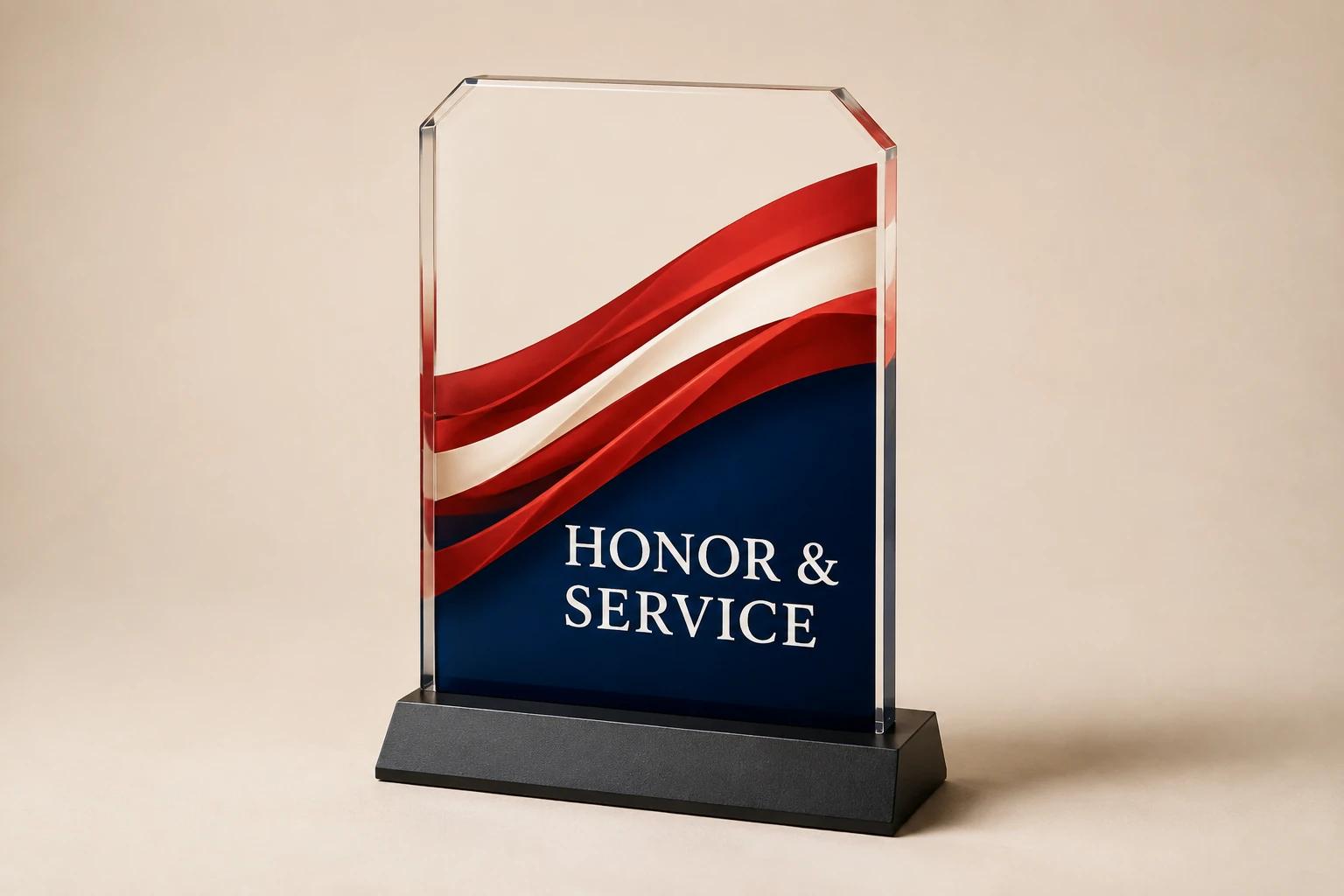
When is full-color decoration the better brief?
Choose a color-led brief when the authorized design depends on specific color relationships that the owner wants represented. Ask for the proposed printing or other decoration method and the way it interacts with clear material. A color image on a white screen does not describe whether the finished award uses an opaque backing, translucent areas or another treatment.
Identify those choices in the proof. If exact color matching is important, ask what physical reference or production proof can address that requirement and how it is quoted. Avoid promising a match from a display image alone. The useful request is an actual color treatment on a specified award construction, with the reviewer’s priorities stated clearly.
How should small lettering and emblem detail be assessed?
Review the motif at the size it will occupy on the award, not merely at its original artwork dimensions. Shrinking the overall emblem also shrinks its lines, spaces and internal lettering. Ask the supplier to identify any detail that needs adjustment for the selected process.
Do not apply another manufacturer’s minimum stroke rule or treat a pixel count as proof of production fit. If a small motto becomes unsuitable, the authorized reviewer can approve a larger motif, a simplified treatment or another design direction. Keep that decision visible instead of allowing an automatic conversion to remove a meaningful element. The final proof should show the emblem in the complete award layout.

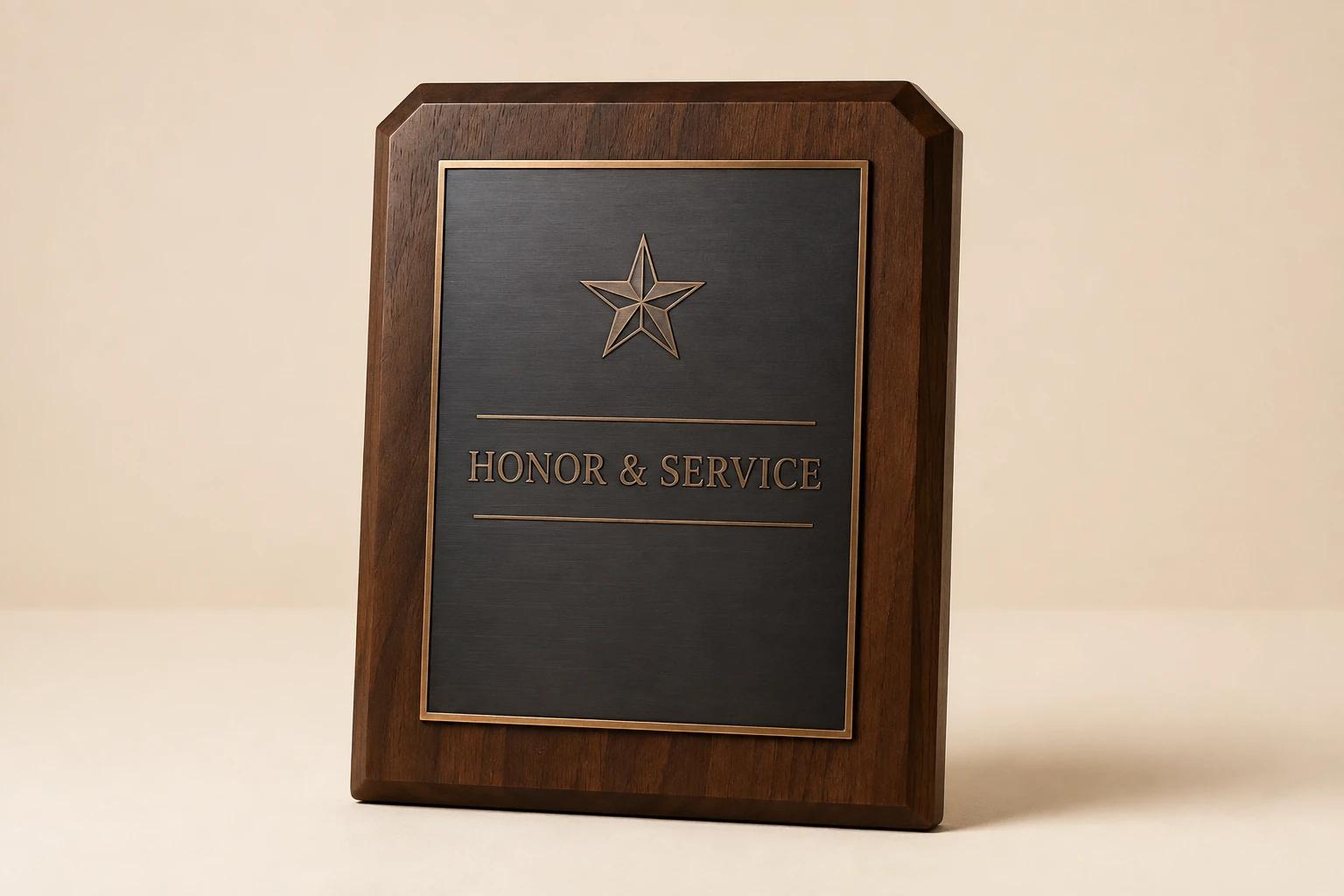
What should the acrylic and base contribute?
Choose the surrounding form to support the emblem’s visibility and the recipient’s intended display. A clear body, colored accent or separate base can change the visual context around the artwork. Ask which surfaces are actually supplied and where the personalization sits.
The service motif should not compete with an unrelated decorative shape simply because both appear in the collection. Review the complete object from the normal viewing side, including the back if it remains visible in the intended setting. Do not infer material composition from terms such as crystal-style. The quote should name the actual acrylic construction so the buyer understands the object being ordered and the image treatment being approved.
How should the two decoration routes be priced?
Provide the same authorized emblem, proposed image size and required features when requesting both options. Ask each quote to identify the acrylic form, decoration method, artwork conversion, proof or sample work, base and shipping. Keep any additional color-reference work explicit.
No Honor Guard Awards selling range or minimum for this configuration is established here; request those figures against the actual scope. A monochrome conversion and a full-color reproduction are different artwork briefs, so their prices should be compared as finished proposals rather than generic engraving versus printing charges. If the reviewer changes the emblem size or essential detail after comparison, obtain an updated description before treating the original quote as final.
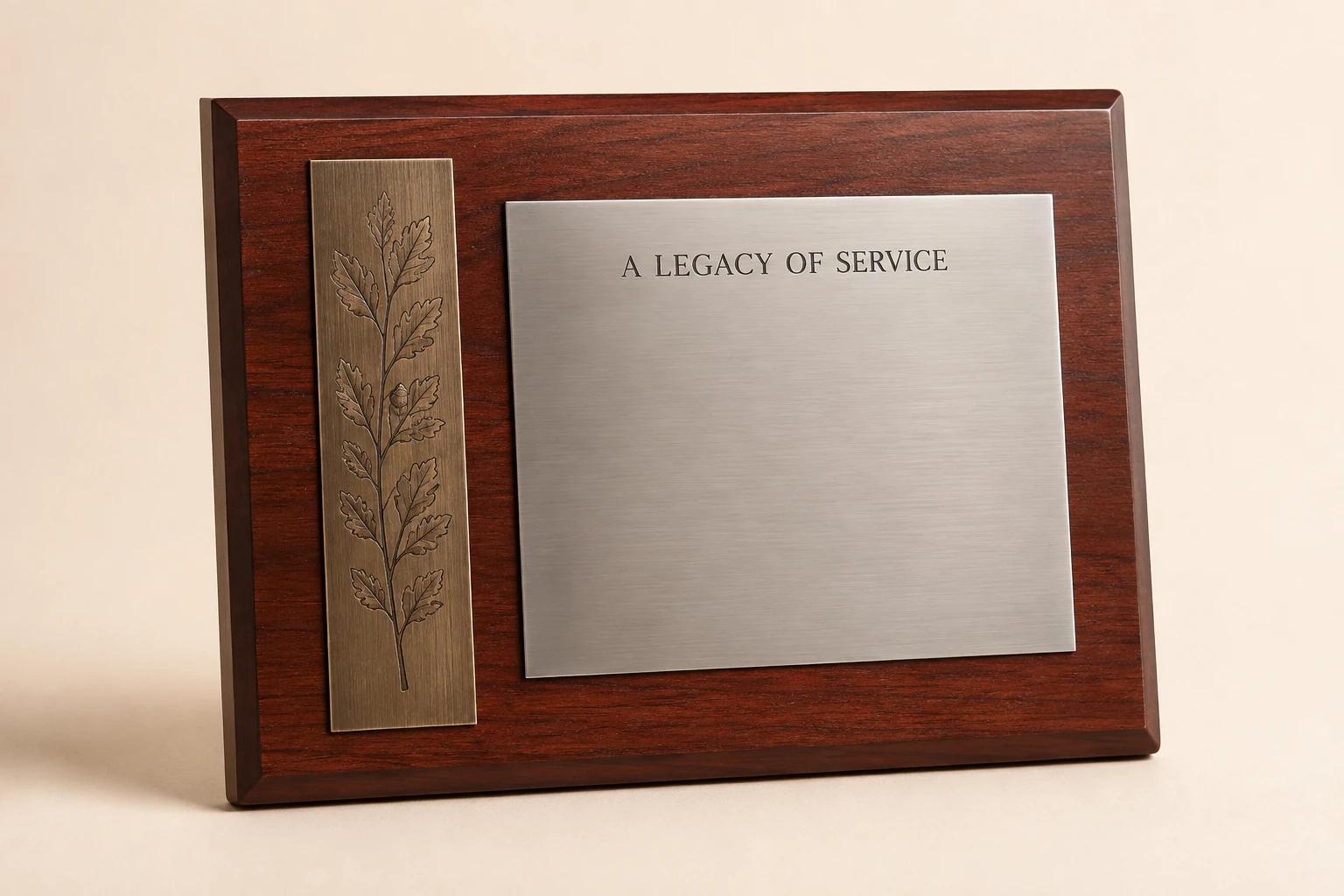
Use the article’s example files
Use the worked comparison as a starting point. Replace its hypothetical dimensions and choices with the supplier’s actual proposal and the owner’s approved requirements.
What should the release file preserve?
Retain the original authorized artwork, approved production interpretation and complete award layout as distinct references. A future copy should use the intended final version rather than whichever color file is easiest to find. Record whether the approved result is monochrome, opaque color or another specifically described treatment.
If the recipient later requests a different acrylic form, recheck the emblem size and background relationship. The same motif can need another production review when moved to a smaller face or a differently colored surface. Keep the personal inscription approval alongside these files without allowing a factual correction to overwrite the emblem’s production reference unintentionally.
How does the illustrative product-selection example work?
In a fictional artwork review, an authorized example motif is drawn 80 millimeters wide with a 2-millimeter line feature. The proposed award layout reduces the motif to 40 millimeters. The coordinator calculates the resulting geometry before asking the supplier to review whether the engraved or printed treatment can represent the feature appropriately.
The scale factor is 40 divided by 80, or one half. The 2-millimeter feature therefore becomes 1 millimeter wide in the reduced drawing. A 60-millimeter motif would use a three-quarter scale and produce a 1.5-millimeter feature. Neither dimension is presented as a production minimum. The worksheet records both proposed sizes and leaves process acceptance on hold. The reviewer can compare a larger motif with a deliberately simplified interpretation, then request the actual supplier’s evidence. The calculation explains what shrinking does to this hypothetical artwork; it does not establish color accuracy, engraving contrast or authorization to use a real service emblem.
Optional calculation: Compare the proposed material descriptions
Which proposed construction fits the intended use?
An engraved interpretation emphasizes an approved monochrome motif, while full-color decoration retains the color relationships requested by the reviewer. A simplified line-art version is a separate design choice that can support either suitable process. Compare essential features and actual-size proof evidence before asking the material name to determine the artwork treatment.
| Option | Engraved monochrome interpretation | Full-color decoration | Approved simplified emblem |
|---|---|---|---|
| Best reason to choose it | Choose this when the authorized motif remains meaningful through an approved single-color treatment. | Choose this when approved color relationships are important to the emblem’s intended identity. | Choose this when selected fine details need a deliberate redesign rather than an unreviewed automatic reduction. |
| What the buyer must review | Review how colored regions become lines, spaces or contrasting engraved areas at the proposed size. | Review opacity, background and any color-reference requirement on the actual proposed acrylic construction. | Confirm which features remain essential and who authorizes the simplified production interpretation. |
| What the quote should identify | Identify the conversion artwork, acrylic treatment, decoration location and finished appearance reference. | Identify the decoration method, artwork layers, physical proof scope and complete award components. | Identify the revised motif and selected decoration route without describing simplification as an exact copy. |
What should you confirm before requesting this product?
Confirm the authorized motif, essential details and intended color treatment before selecting the award’s decoration method. The original artwork and production interpretation serve different purposes. An actual-size review should reveal what shrinks or changes, while the supplier’s proposal identifies the acrylic construction and the evidence needed to approve the finished reproduction.
What affects the cost of engraved versus full-color acrylic emblems?
Request Honor Guard Awards pricing for the same motif size and award construction, including artwork conversion, decoration, sample or color-reference work, base and shipping. Ask for the applicable minimum or range. A simplified monochrome interpretation and a full-color design are different scopes, so compare their complete proposed outputs rather than method labels alone.
Can the original color emblem be used unchanged for engraving?
Ask to review the actual production interpretation. Color-separated areas may need another visual distinction in a monochrome treatment. The authorized reviewer should approve those changes, including any simplified detail. A correct source file does not establish that an automatic conversion preserves the emblem’s intended meaning on the selected acrylic.
Does full-color printing guarantee a screen color match?
Do not infer a physical match from an electronic preview. Ask how the proposed process, backing and acrylic affect the intended appearance, and request an appropriate reference or proof when color accuracy is important. The supplier should describe that scope for the actual order rather than the buyer borrowing assurances from another product.
What does the 80-to-40-millimeter example demonstrate?
It demonstrates proportional reduction: a motif at half its original width also reduces a 2-millimeter line to 1 millimeter. The example does not state that either size is manufacturable. Record the resulting geometry and ask the actual supplier to review it for the proposed engraving or color-decoration process.
Who approves changes to an emblem’s detail?
Use the designated person responsible for the supplied artwork and its intended use. The designer can explain production options, but removing lettering or altering a meaningful feature should receive explicit review. Keep the approved interpretation with the original reference so a later copy does not accidentally restore an unapproved or unsuitable version.
Sources and scope
The sources below support the cited technical details. The ordering workflows are editorial recommendations. Your project specification, price and schedule are established in the written quote and approved proof.
- Acrylic Idea Factory: Best Sellers Catalog · checked 2026-09-05
Which buying guide should you read next?
All buying guidesFor worldwide Honor Guard Awards orders, write a retirement plaque around an approved career transition and a memorial tribute around the family’s chosen remembrance. Confirm the occasion before selecting dates or borrowing an earlier inscription. Service dates, life dates and the presenters’ personal message should retain their distinct meanings in the proof.
For worldwide Honor Guard Awards orders, proof the rank and every date by their intended meaning before refining the retirement gift’s layout. Use the authorized reviewer’s exact title, abbreviation and date wording. A character check can reveal long lines, but it cannot verify service history or decide which appointment the gift should recognize.